In 2026, reliability labs are under pressure to qualify more SKUs — EV battery modules, automotive electronics, consumer devices — on tighter schedules and with less budget flexibility. Electricity prices have risen across most major manufacturing regions, and sustainability reporting requirements mean that energy consumption per test is no longer just an OPEX line item: it is a metric that procurement and ESG teams are actively tracking.
For labs evaluating thermal shock testing equipment, two pressures converge at the same decision point. The first is performance: switching speed, temperature range, recovery time, and cycle repeatability all determine how many tests a chamber can complete per week. The second is cost: refrigeration duty cycles, heater power, and defrost interruptions determine what each completed test actually costs to run.
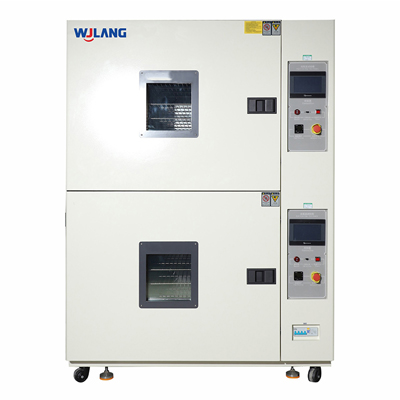
Many teams are also comparing suppliers globally, including thermal shock chamber China manufacturers, to reduce CAPEX. But the more consequential decision is usually architecture — specifically, whether a 2-zone or 3-zone thermal shock system better matches your test standard, specimen behavior, and throughput target. Getting that choice right has a larger impact on total cost per test than the purchase price difference between vendors.
This article explains how 2-zone and 3-zone architectures differ in working principle, where each one wins on throughput and OPEX, and how to specify energy-efficient test chambers with rapid temperature recovery for your 2026 lab expansion or replacement cycle.
2-Zone vs 3-Zone Thermal Shock: What Changes in the Working Principle and Why Throughput Shifts
The fundamental difference between 2-zone and 3-zone thermal shock systems is not just the number of chambers — it is how the specimen transitions between temperature states and what happens to the stored thermal energy in each zone during that transition.
2-Zone Architecture
A 2-zone thermal shock chamber contains two pre-conditioned zones: one held at the high temperature setpoint and one held at the low temperature setpoint. The specimen — either the basket or the specimen itself, depending on design — is transferred mechanically between the two zones. The transfer happens rapidly, typically within seconds, and the specimen experiences an immediate, aggressive thermal shock on arrival in the new zone.
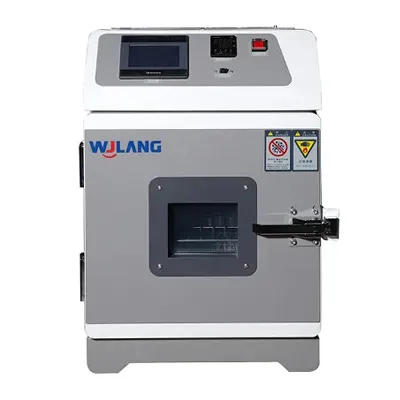
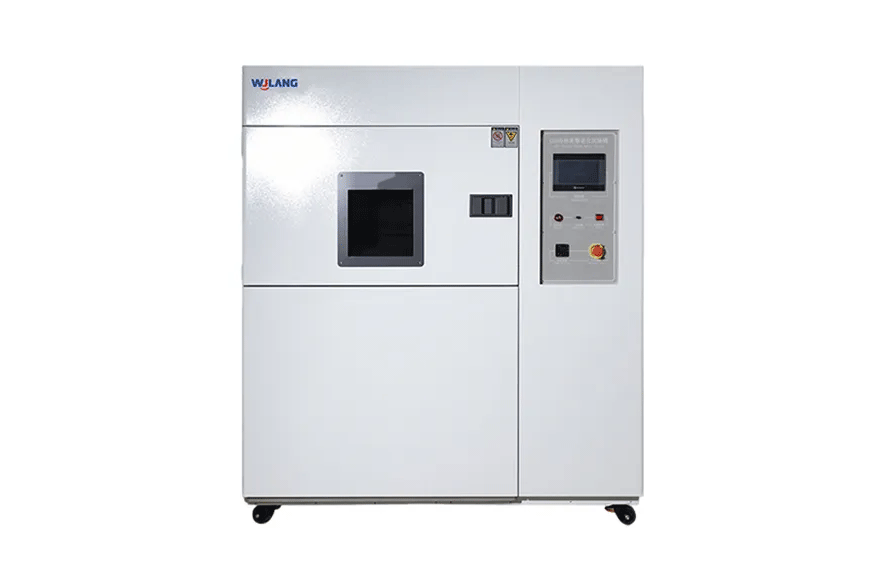
WJLANG's 2-zone designs target a switching time of 10 seconds or less, which is consistent with the aggressive transition requirements in standards like IEC 60068-2-14 and MIL-STD-883. Because there are only two zones, the system is mechanically simpler and the control logic is straightforward: pre-condition, transfer, soak, transfer back, repeat.
The throughput advantage of 2-zone is that every cycle is a direct hot-to-cold or cold-to-hot transition with no intermediate state. For high-volume screening of electronics — solder joint qualification, connector cycling, PCBA stress screening — this simplicity translates to maximum shock aggressiveness and a clean cycle structure that is easy to validate against a standard.
3-Zone Architecture
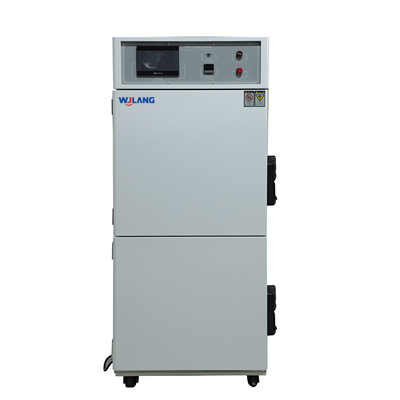
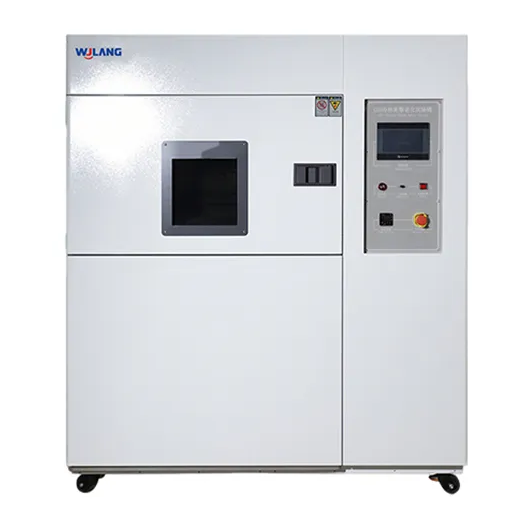
A 3-zone thermal shock chamber adds a third zone: a normal-temperature or ambient transition zone positioned between the hot and cold zones. The specimen passes through this intermediate zone during transfer, and the zone transitions between temperature states are managed through valve and airflow switching rather than purely mechanical basket movement.
The practical effect is that the hot and cold zones are less disturbed during each transfer cycle. When a specimen moves from the hot zone to the ambient zone, the hot zone door closes and the hot zone begins recovering immediately rather than waiting for the full transfer to complete. This reduces the thermal disturbance to stored energy in each zone and can improve recovery time consistency across consecutive cycles.
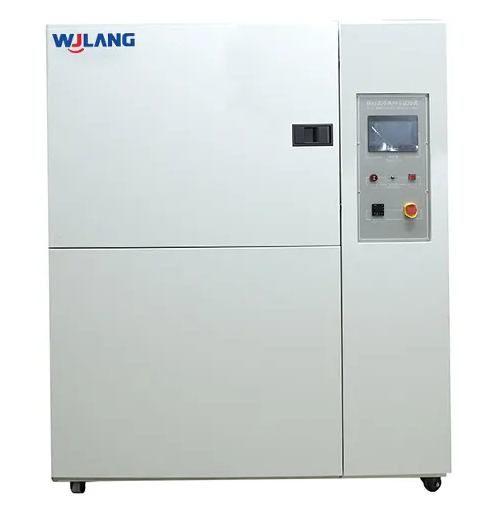
WJLANG's 3-zone documentation describes temperature recovery within 5 minutes as a benchmark for the mini three-zone model — a figure that reflects the benefit of managed zone isolation during transfer.
Which Architecture to Choose
Criterion
2-Zone
3-Zone
Shock aggressiveness
Maximum — direct hot/cold transfer
Slightly moderated by ambient dwell
Cycle structure
Simpler — two states only
More flexible — intermediate state available
Recovery time consistency
Good
Improved — zones recover in parallel
Intermediate inspection or measurement
Not supported without breaking cycle
Supported via ambient zone dwell
Scheduling flexibility
High for simple profiles
Higher for complex or mixed profiles
Mechanical complexity
Lower
Higher
Choose 2-zone when maximum shock aggressiveness and the simplest cycle structure are the priority. Choose 3-zone when you need an intermediate state for measurement or inspection, when load stability and recovery repeatability across long unattended runs matter, or when your test plan includes specimens that benefit from a controlled ambient dwell between extremes.
Energy-Efficient Test Chambers: Where OPEX Is Won or Lost in Thermal Shock Testing
Thermal shock chambers are among the highest-power-consuming equipment in a reliability lab. A chamber running 24 hours a day, 5 days a week, across a 50-week year accumulates significant electricity consumption — and at 2026 industrial electricity rates, that consumption is a material budget line.
The main OPEX cost drivers in thermal shock testing are:
Refrigeration duty cycle: how hard the compressor works to maintain setpoint and recover after each transfer
Heater power: how much energy is required to maintain and recover the hot zone
Airflow losses: energy lost through door seals, basket mechanisms, and zone transitions
Defrost strategy: how often defrost cycles run, how long they take, and whether they interrupt scheduled test runs
Recovery time after load changes: longer recovery means more compressor run time per cycle
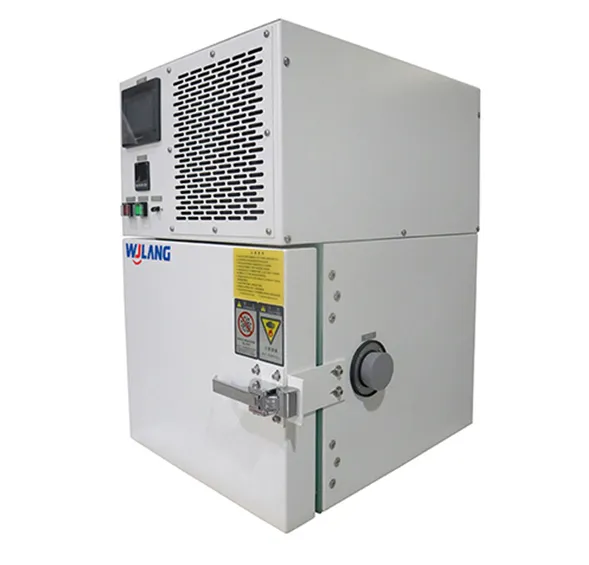
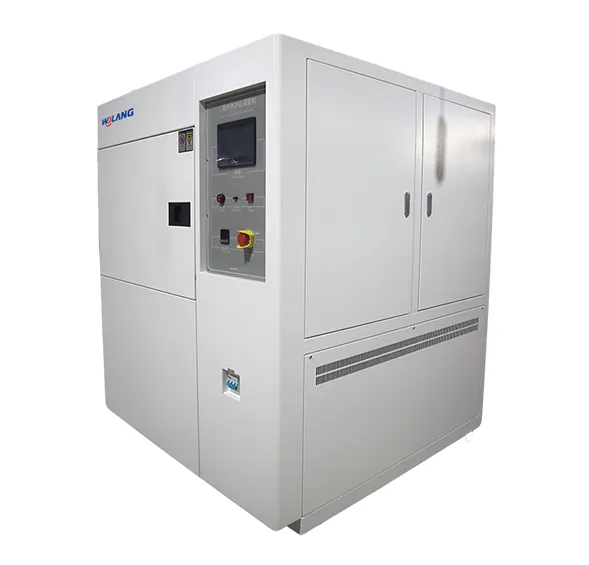
WJLANG positions its mini 2-zone and 3-zone units with an energy-saving design and air-cooling condensation. Air-cooled condensation eliminates the need for a cooling tower or chilled water supply, which reduces both installation cost and ongoing utility infrastructure. For labs that cannot easily access cooling water — or that want to avoid the maintenance overhead of a water-cooling loop — this is a meaningful deployment simplification.
When evaluating energy efficiency across vendors, the most useful metric to request is kWh per completed cycle under your specific test profile — not peak power draw or nameplate rating. A chamber with a lower nameplate rating but poor recovery behavior may consume more energy per test than a higher-rated chamber with fast, efficient recovery.
Practical questions to ask during procurement:
What is the measured kWh per cycle at your target temperature range and soak time?
What is standby power consumption between test runs?
How does the defrost cycle interact with scheduled test windows — can it be programmed to run during off-hours?
What is the door-open recovery time and energy cost after loading a new specimen batch?
Rapid Temperature Recovery and Cycle Time: The Hidden KPI for Lab Throughput
Switching speed — the time to transfer a specimen from one zone to another — is the specification most prominently featured in thermal shock chamber marketing. It is also the least important component of total cycle time in most real-world test profiles.
Total cycle time for a thermal shock test is the sum of:
Cycle time = Transfer time + Soak time + Recovery time + Ambient dwell (3-zone) + Defrost interruptions
Transfer time is typically 10 seconds or less in modern chambers. Soak time is defined by the test standard — often 30 minutes per extreme for electronics standards. Recovery time — the time from specimen arrival in a zone to the moment the zone returns to setpoint within the required uniformity tolerance — is where significant variation exists between chambers and where throughput is actually won or lost.
If a chamber takes 15 minutes to recover to setpoint after each transfer, and your soak time is 30 minutes, recovery represents 33% of the active cycle time. Reducing recovery from 15 minutes to 5 minutes — a 10-minute improvement — reduces active cycle time by roughly 20% and increases the number of cycles completable per day by a proportional amount.
WJLANG's mini three-zone model targets recovery within 5 minutes, which is a practical benchmark to use when comparing vendors. When requesting this figure, specify the conditions: recovery time at what load mass, at what temperature setpoint, after what transfer scenario. Recovery time under no-load conditions is not a useful procurement metric.
The other throughput factor that is frequently underestimated is defrost. Ice accumulation on the cold zone heat exchanger is unavoidable in thermal shock testing, and defrost cycles — if not managed — can interrupt test runs at unpredictable intervals. Chambers with programmable defrost scheduling allow labs to align defrost windows with shift changes, lunch breaks, or overnight gaps, protecting the throughput of scheduled test runs.
Thermal Shock Chamber China Use Cases: Where 2-Zone or 3-Zone Fits Best
Electronics: PCBA, Solder Joints, Connectors
High-volume electronics screening prioritizes fast shock and repeatable cycle structure. 2-zone architecture is the standard choice for solder joint qualification, connector cycling, and PCBA stress screening under IEC 60068-2-14 or JEDEC standards. The direct hot-to-cold transfer maximizes thermal gradient across the specimen, which is the mechanism that reveals solder fatigue, delamination, and connector contact degradation.
For electronics labs running multiple chambers in parallel, the simplicity of 2-zone control logic also reduces operator training time and simplifies data management across chambers.
Automotive and EV Components
Automotive and EV component qualification often involves larger specimens — battery modules, power electronics assemblies, thermal management components — and more complex test plans that may include intermediate inspection points or electrical measurements during the test sequence. 3-zone architecture supports these requirements by providing an ambient zone where specimens can be accessed, measured, or inspected without terminating the test cycle.
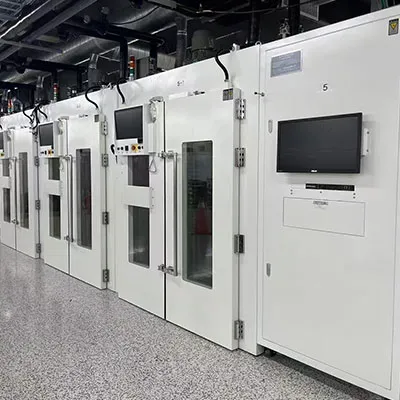
WJLANG's work in EV battery component reliability testing reflects this use case: the ability to manage zone transitions without disturbing stored thermal energy is particularly valuable when specimens are large and recovery time is a significant fraction of total cycle time.
Aerospace and Defense
Aerospace and defense qualification emphasizes uniformity, traceability, and long unattended runs. The key specifications are temperature uniformity across the working volume, calibration traceability to national standards, alarm and data logging capability, and defrost strategy that supports 24-hour unattended operation. Both 2-zone and 3-zone architectures can meet these requirements, but the selection should be driven by the specific standard (MIL-STD-883, DO-160, or customer specification) and the specimen handling requirements.
Selection, Installation, Maintenance, and TCO: How to Choose Without Overbuying
Selection Checklist
Parameter
What to Specify
Notes
Architecture
2-zone vs 3-zone
Based on test standard and specimen handling needs
Temperature range
Low / high setpoints
Confirm range covers your standard with margin
Switching time
Target in seconds
Verify under load, not empty chamber
Recovery time
Target in minutes
Specify load mass and setpoint conditions
Working volume
Basket dimensions and usable volume
Include fixture mass in load calculation
Utilities
Air-cooled vs water-cooled
Air-cooled simplifies installation; confirm heat rejection space
Power supply
Voltage, phase, amperage
Confirm lab capacity before ordering
Data and control
PLC/HMI, recorder, alarms, remote monitoring
Match to traceability and unattended run requirements
Energy metric
kWh/cycle or kWh/day at target profile
Request measured data, not nameplate rating
Installation Notes
Most modern thermal shock chambers from WJLANG and comparable suppliers are designed for straightforward lab installation. Air-cooled models require adequate ventilation clearance around the condenser — typically 300–500mm on the heat rejection side — and a stable power supply at the specified voltage and phase. No cooling tower, chilled water loop, or special drainage is required for air-cooled configurations.
Confirm floor load capacity for larger models. Thermal shock chambers with large refrigeration systems can be heavy, and some lab floors — particularly in older buildings — may require reinforcement or load distribution plates.
Maintenance and TCO
The highest-cost maintenance failure mode in thermal shock testing is not compressor failure — it is retest. A chamber that produces non-repeatable results due to poor temperature uniformity, sensor drift, or inconsistent recovery forces labs to repeat completed tests, which consumes chamber time, energy, and labor at full cost with no productive output.
Preventive maintenance priorities:
Clean heat exchangers on a scheduled basis — fouled exchangers increase compressor run time and reduce recovery speed
Inspect and replace door seals when wear is visible — leaking seals increase energy consumption and reduce zone isolation
Calibrate temperature sensors and verify uniformity across the working volume at least annually, or after any significant maintenance event
Program defrost cycles to align with non-test windows — protect throughput by keeping defrost out of scheduled run time
Log recovery time per cycle as a routine KPI — gradual degradation in recovery time is an early indicator of refrigeration system issues
Process Diagram: Thermal Shock Testing Cycle and Throughput Drivers
Alt text: Workflow showing 2-zone vs 3-zone thermal shock testing cycle steps, highlighting recovery time as the primary throughput KPI alongside transfer speed and defrost management.
Caption: Throughput in thermal shock testing is driven by recovery time, soak time, and defrost strategy — not only the hot-to-cold switching speed. Optimizing all three reduces cycle time and OPEX simultaneously.
Conclusion
If your 2026 lab target is more completed tests per week at lower OPEX, the architecture decision — 2-zone vs 3-zone thermal shock — is the highest-leverage choice you will make in chamber procurement. 2-zone delivers maximum shock aggressiveness and cycle simplicity for high-volume electronics screening. 3-zone adds intermediate-state flexibility and improved recovery consistency for automotive, EV, and complex specimen profiles.
Beyond architecture, specifying for energy-efficient test chambers with rapid temperature recovery — and managing defrost scheduling to protect throughput windows — determines what each completed test actually costs to run. WJLANG's thermal shock chamber lineup covers both architectures with ultra-fast switching, energy-saving refrigeration design, and air-cooled installation that reduces deployment complexity.
Understand the difference between thermal shock and thermal cycling before finalizing your selection
Submit the following details to receive a recommended specification and pricing:
Parameter
What to Provide
Work condition
Industry and standard (IEC / MIL / internal spec), operating hours, unattended night run requirement
Quantity
Specimen batch size, cycles per week, parallel chamber requirement
Size and spec
Specimen dimensions and weight including fixtures, target temperature range, switching and recovery time targets
Target metrics
Cycle time target, kWh per day or per cycle, temperature uniformity requirement, data traceability needs
Current problem
High electricity cost, slow recovery, defrost-related downtime, temperature overshoot, insufficient throughput
FAQ
1. What is thermal shock testing?
Thermal shock testing exposes specimens to rapid transitions between extreme high and low temperatures to reveal weaknesses caused by sudden thermal stress. It is used to qualify electronics, automotive components, and aerospace modules by identifying failures — such as solder joint cracking, delamination, or connector degradation — that only appear under fast, severe temperature changes. A dedicated thermal shock chamber pre-conditions both temperature extremes simultaneously so the specimen experiences the full gradient immediately on transfer.
2. How does thermal shock testing compare to thermal cycling?
Thermal cycling uses controlled temperature ramps and equilibrated soaks to study fatigue accumulation over many cycles. The specimen temperature changes gradually, and the test is designed to reveal failures caused by repeated expansion and contraction over time. Thermal shock focuses on the speed and severity of the transition itself — the specimen moves from one extreme to the other in seconds, and the failure mechanism is the immediate stress from the sudden gradient rather than accumulated fatigue. The two methods are complementary and are often specified together in qualification programs, but they use different equipment and target different failure modes.
3. What ROI or payback should we expect from upgrading to an energy-efficient thermal shock chamber?
ROI comes from three sources: shorter cycle time from faster recovery increases the number of tests completable per chamber per week, better repeatability reduces retests which are the most expensive form of wasted chamber time, and lower energy consumption per cycle reduces the electricity cost of each completed test. The most useful way to model payback is to calculate kWh per cycle multiplied by cycles per week, then compare that figure against your current chamber's measured consumption. Labs running chambers at high utilization typically see payback within 18 to 36 months from energy savings alone, with additional value from throughput improvement.
4. Do we need to modify our lab to install a new thermal shock chamber?
The main installation requirements are power supply capacity, heat rejection space, and floor load. Air-cooled models — which WJLANG offers — eliminate the need for a cooling tower or chilled water loop, significantly reducing installation complexity compared to water-cooled configurations. You will need to confirm that your lab's electrical supply matches the chamber's voltage, phase, and amperage requirements, and that there is adequate clearance around the condenser for heat rejection. Most standard lab environments can accommodate these requirements without structural modification.
5. What parameters do we need to provide to get the right thermal shock chamber specification?
At minimum: target temperature range for both hot and cold zones, required switching time, recovery time target under your expected load mass, specimen and fixture dimensions and weight, required working volume, applicable test standard, run profile (continuous or intermittent, attended or unattended), defrost constraints, data logging and traceability requirements, and your throughput KPI in cycles per day or per week. If you are comparing 2-zone and 3-zone options, also specify whether your test plan requires an intermediate inspection or measurement step between temperature extremes.
Vietnam Wujinglang Technology
Vietnam Wujinglang Co., Ltd. is a high-precision reliability test equipment R&D & manufacturing provider, offering global environmental simulation and extreme test solutions for electronics, automobiles, aerospace, adhering to customer-first culture for sustainable development.
We use cookies to offer you a better browsing experience, analyze site traffic and personalize content. By using this site, you agree to our use of cookies.
Visit our cookie policy to learn more.
 English
  日本語
日本語  한국어
한국어  français
  Deutsch
  русский
  tiếng việt
  ไทย
ไทย  Malay
Malay 

 Know More