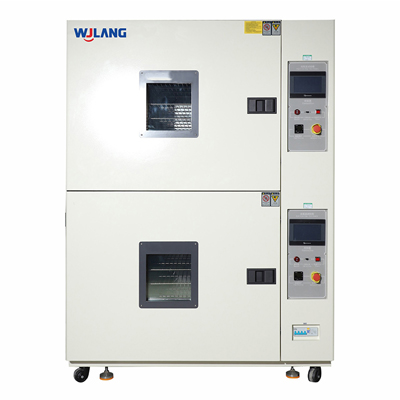
Industrial oven performance is often reduced to one number: maximum temperature. That number matters, but it does not tell a process engineer whether every part on every shelf receives the same thermal exposure. A chamber can hold the control sensor close to setpoint while the front, rear, top, bottom or center of a loaded workspace runs several degrees hotter or colder. If the process involves adhesive curing, coating drying, battery material drying, electronic aging, polymer conditioning or heat treatment, that spatial difference can create inconsistent quality even though the display appears stable.
Temperature uniformity is the result of the entire oven system. Heater capacity, fan selection, duct geometry, supply and return locations, insulation, door sealing, sensor placement, shelf design, product arrangement, moisture release and internal heat generation all interact. The same oven may perform well when empty and poorly when fully loaded. A process that succeeds with small parts may fail after production scales to dense racks. For this reason, an oven should be selected and accepted against the real load and process, not only an empty-chamber catalog specification.
This guide explains how industrial oven airflow works, why loading changes uniformity, how different oven types compare, how to plan a temperature uniformity survey, which safety questions belong in the RFQ, and how to evaluate total cost. It uses published WJLANG data as practical examples. Selected WJLANG high-temperature oven models are specified from room temperature plus 10°C to 200°C, with published stability of ±0.2°C and 1°C temperature uniformity measured by a nine-point distribution test under stated conditions. These figures should be confirmed for the selected model, load and acceptance procedure.
What Is Industrial Oven Temperature Uniformity?
Industrial oven temperature uniformity is the spatial difference among measured locations in the usable workspace after the oven reaches a defined steady condition under a specified load.
Uniformity should not be confused with controller accuracy or temperature stability. Controller accuracy describes how closely the indicated value corresponds to a reference. Stability describes how much temperature at one point fluctuates over time. Uniformity describes differences from one location to another. An oven can have stable control at the reference sensor and still have a large spatial gradient.
The measurement condition is essential. Was the oven empty or loaded? How many points were measured? Were sensors placed near walls or only in the center? Was the door recently opened? How long did the oven stabilize? Was the product releasing moisture? Was the fan at the intended speed? A statement such as “uniformity ±1°C” is meaningful only when these conditions are documented.
WJLANG publishes a nine-point distribution measurement and 1°C uniformity for selected 200°C models. Nine points are commonly used to represent corners and the center of a rectangular workspace, but the correct survey for a production process may require more sensors, especially when the chamber is large, the load is dense or the process is critical. A validation plan should follow the applicable quality system, customer requirement and standard.
How Does an Industrial Oven Work?
An industrial oven heats a controlled workspace and uses natural or forced air movement, vacuum or another heat-transfer method to deliver thermal energy to a product for drying, curing, aging or heat treatment.
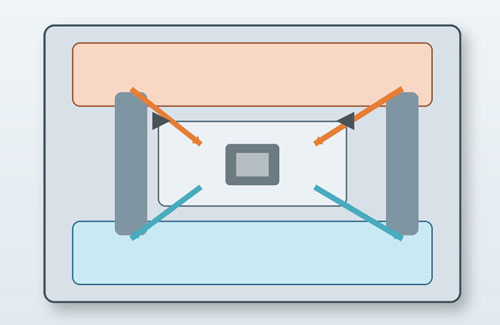
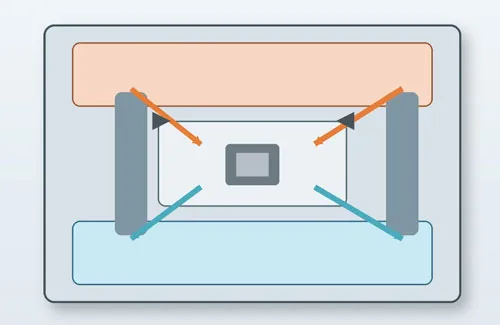
In a forced-convection industrial oven, electric heaters or another heat source warm circulating air. A fan moves the air through supply ducts into the workspace, across the load and back through return passages. A temperature controller compares sensor feedback with the setpoint and adjusts heater output, often through PID control and solid-state switching. Insulation limits heat loss, while door seals and pressure-relief features help maintain the internal condition.
The airflow circuit determines how evenly heat reaches the load. A well-designed system does not simply move a large volume of air; it distributes air where it is needed and returns it without creating short circuits. If supply air immediately returns to the fan without passing through the product, the control sensor may report good performance while parts remain cold. If air velocity is too high, lightweight products can move or dry unevenly. If velocity is too low, boundary layers around the product slow heat transfer.
Natural-convection ovens rely on buoyancy. Hot air rises and cooler air falls, creating gentle circulation without a fan. This can be suitable when forced airflow would disturb powders, films or delicate samples, but spatial gradients and heat-up time may be greater. Vacuum ovens reduce pressure so moisture or solvents can evaporate at lower temperatures and oxygen exposure can be reduced. They solve a different process problem and should not be selected merely because the product needs “better drying.”
Heat reaches a product through convection, radiation and conduction through fixtures or shelves. The relative contribution changes with temperature, geometry, surface finish and contact. At higher temperatures, radiation becomes more significant. A dense metal fixture can act as a heat sink during warm-up and a heat source during cool-down. The oven design and recipe must account for the whole thermal system.
Why Do Airflow and Duct Design Control Industrial Oven Uniformity?
Airflow and duct design control industrial oven uniformity by determining the velocity, direction and temperature of air reaching each part of the load and by preventing hot or cold zones from persisting.
Supply and return placement should create a complete circulation path through the usable workspace. Common arrangements include horizontal airflow, vertical downflow, vertical upflow and combinations tailored to racks or trolleys. The best arrangement depends on the product. Horizontal airflow can work well for trays with open spacing. Vertical airflow may suit stacked parts if shelves are perforated and pressure is balanced. Large solid panels can block either arrangement and require side gaps or custom ducts.
Fan performance must be considered at operating temperature and system resistance. A fan that produces adequate flow in an empty chamber may lose effective distribution when filters, ducts, shelves and a dense load increase pressure drop. Variable-speed control can be useful when different products require different velocities, but speed changes should be validated because they alter heat transfer and uniformity.
Heater location also matters. If heaters create local radiant hot spots or if air is not mixed before entering the workspace, parts near the supply can overheat. Mixing plenums, baffles and perforated distribution panels can reduce these differences. The control sensor should be placed where it represents the process, not simply where it produces the fastest response.
Door leakage and wall losses create cold zones, especially near large openings. Repeated door opening can produce long recovery times and inconsistent batches. For production ovens, loading and unloading strategy, door design, seals and air curtains may be as important as heater power.
How Does Product Loading Change Oven Performance?
Product loading changes oven performance by adding thermal mass, blocking airflow, releasing moisture or heat and creating new heat-transfer paths that do not exist during an empty-chamber test.
A no-load uniformity result is useful for verifying the oven itself, but it does not prove process uniformity. Products and fixtures can occupy the same space where air needs to move. A rack placed directly against a supply panel can cause a high-velocity hot zone at the inlet and a cold zone downstream. Closely spaced trays can starve the center of the load. Large containers can trap cool air. Moist products can cool nearby air through evaporation and increase humidity, changing drying behavior.
Thermal mass changes warm-up time. An empty oven may reach 200°C quickly, while a fully loaded batch takes much longer for the coldest product core to reach the process temperature. If the recipe begins its hold time when the oven display reaches setpoint, different loads receive different effective exposure. A more robust process starts the dwell after a representative product sensor reaches the required temperature or after a validated delay.
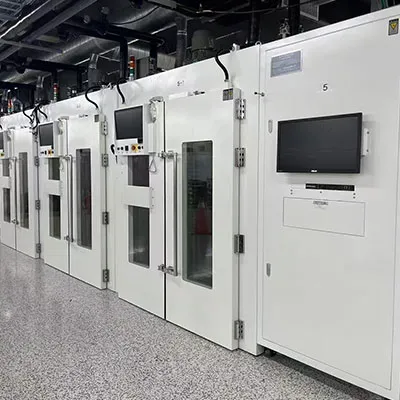
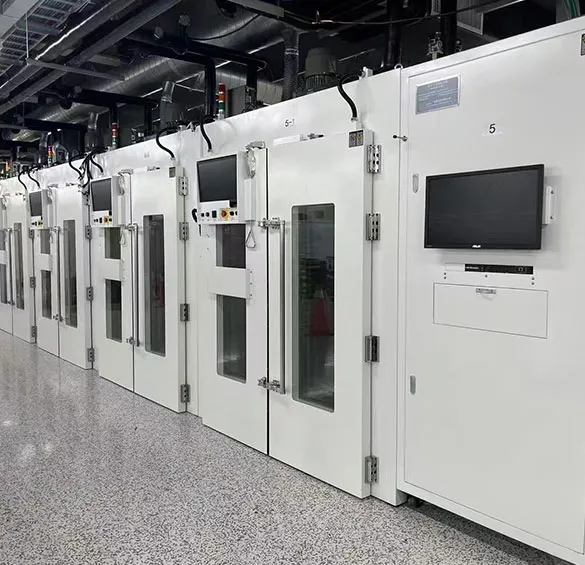
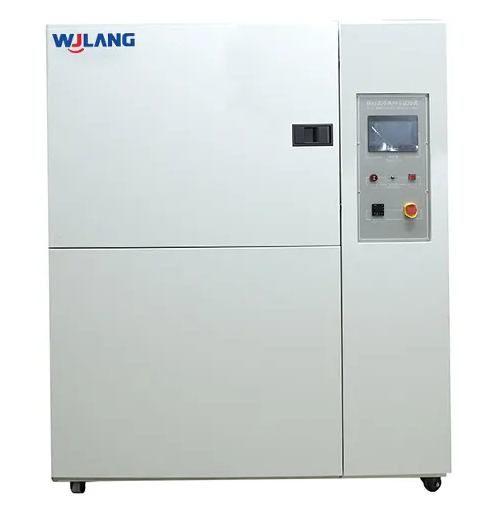
Published WJLANG data for a large-volume temperature chamber illustrates the importance of load conditions. The page distinguishes no-load and full-load stability, deviation and uniformity, and notes a possible 10°C to 12°C difference between trolley inlet and outlet under a particular full-load condition. This does not describe every oven, but it shows why a supplier should discuss the loaded airflow path honestly rather than presenting only an empty-chamber figure.
To improve repeatability, standardize the number of parts, rack position, tray type, spacing, orientation and maximum load. Mark approved locations. Use fixtures that allow air movement. Avoid mixing products with very different mass or moisture content unless the process has been validated for that combination.

Forced-Convection, Gravity-Convection, and Vacuum Ovens: How Do They Compare?
Forced-convection, gravity-convection and vacuum ovens use different heat- and mass-transfer mechanisms, so they differ in uniformity, drying behavior, product disturbance and process safety.
| Oven type | Heat and mass transfer | Typical strengths | Typical limitations | Best questions before selection |
|---|
| Forced-convection oven | Fan circulates heated air across the load | Faster heat transfer, improved uniformity, scalable production loading | Airflow can disturb light products; poor loading can block circulation | What airflow pattern, velocity, load and uniformity are required? |
| Gravity-convection oven | Natural buoyancy circulates heated air | Gentle air movement, fewer moving parts, suitable for some delicate samples | Slower response and potentially larger spatial gradients | Can the process tolerate longer heat-up and broader uniformity? |
| Vacuum drying oven | Reduced pressure lowers boiling point and removes vapor through a vacuum system | Lower-temperature drying, reduced oxygen, useful for trapped moisture or sensitive materials | Lower convective heat transfer, more complex sealing and vacuum controls, smaller throughput in many designs | What final pressure, vapor load, solvent, product temperature and pump compatibility are required? |
| Inert-atmosphere oven | Heated environment with controlled gas composition | Reduces oxidation or supports a defined atmosphere | Gas consumption, oxygen monitoring, purge validation and safety complexity | What oxygen limit, purge rate, gas purity and exhaust controls are required? |
| Walk-in or trolley oven | Large forced-air workspace for racks, carts or assemblies | High capacity and production handling | Greater gradients, facility heat rejection, floor and door considerations | How will trolleys be loaded, sealed, mapped and moved? |
Vacuum and forced-air ovens should not be treated as interchangeable versions of the same product. In a forced-air system, evaporation depends on surface temperature, air velocity, humidity and exhaust. In a vacuum system, pressure changes the boiling point and vapor-removal mechanism. If flammable solvents are present, the hazard analysis must consider vapor concentration, ignition sources, exhaust, purge, vacuum-pump compatibility and applicable codes. A generic “explosion-proof” label is not a complete safety design.
What Specifications Matter When Buying a High Temperature Industrial Oven?
The critical specifications for a high temperature industrial oven are operating range, stability, spatial uniformity, loaded heat-up time, airflow, exhaust, workspace, load capacity, controls, safety and facility requirements.
A high temperature industrial oven should be specified around the process temperature, not only the maximum rating. Continuous operation near the upper limit can affect heater life, insulation, seals, fan bearings and control components. Ask whether the maximum is a short-term or continuous operating value and what derating applies with a full load.
Temperature stability and uniformity should be defined separately. State the tolerance needed at the product, the survey condition, sensor count and usable workspace. If the process requires ±2°C at the product, an oven specified at ±2°C air uniformity may not be sufficient once load variation and measurement uncertainty are included.
Heat-up time must include the load. A WJLANG 200°C model is published with approximately 45 minutes from room temperature to 200°C under specified conditions. The loaded process may take longer. The RFQ should state product mass, fixture mass, starting temperature and acceptable time to reach the coldest product point.
Airflow should be described by pattern and process effect, not only fan power. Request adjustable speed if products vary, but require validation at each approved setting. Exhaust flow matters for moisture and volatile removal. Too little exhaust slows drying; too much exhaust wastes energy and can create cold zones. The oven may need controlled fresh-air intake and exhaust balancing.
Workspace dimensions should include rack, trolley, shelf, door and maintenance clearances. Specify floor loading and shelf loading. If a trolley is used, provide wheel tracks, seals, ramp and operator handling requirements. For line integration, define conveyors, interlocks and upstream/downstream timing.
Controls should record setpoint, actual temperature, alarms, recipe steps and relevant events. Data export, user access, audit trail and network communication may be required by the quality system. Confirm sensor type, calibration access and replacement procedure.
How Should Industrial Oven Temperature Uniformity Be Validated?
Industrial oven uniformity validation maps temperature at representative locations and operating conditions to confirm that the usable workspace and process load remain within the approved tolerance.
Begin with a written protocol. Define the oven, sensor calibration status, setpoints, load, fan speed, exhaust position, stabilization criterion, measurement interval, sensor locations, acceptance limits and treatment of deviations. Identify whether the survey is for equipment qualification, process validation, periodic verification or troubleshooting.
For a rectangular chamber, a basic empty survey may place sensors near corners and the center. Larger or critical ovens require more points. A loaded survey should include locations expected to be hottest and coldest, such as near supply air, return air, doors, walls, the center of dense racks and product cores. Sensors should be secured so they do not touch metal surfaces unless surface temperature is intentionally measured.
Allow the oven to reach a defined steady state. Record long enough to observe control cycling and spatial behavior. Evaluate maximum, minimum, average, range and time variation. The analysis should consider measurement uncertainty and calibration accuracy. A single snapshot is not enough.
If the oven fails, do not immediately adjust the controller. Determine whether the cause is airflow blockage, fan direction, baffle position, heater imbalance, door leakage, sensor placement, load arrangement, exhaust setting or control tuning. Correct the physical cause and repeat the survey. Changing the control offset can hide a gradient without improving product exposure.
Periodic survey frequency should follow the applicable standard, quality system, process risk, maintenance history and change control. Requalification may be needed after moving the oven, changing fans or ducts, replacing major heaters, modifying controls, changing the approved load or observing unexplained product variation.
How Do ASTM E145 and AMS2750 Relate to Oven Performance?
ASTM E145 addresses performance characteristics for laboratory convection ovens, while SAE AMS2750 defines pyrometry requirements used in aerospace thermal processing; the applicable document depends on the oven’s purpose and customer requirements.
ASTM E145 is commonly referenced for gravity-convection and forced-ventilation ovens used in laboratory testing. It provides a framework for performance characteristics rather than a universal process recipe. SAE AMS2750 is a detailed pyrometry specification associated with aerospace heat-treatment systems and covers instrumentation, sensors, calibration, system accuracy tests and temperature uniformity surveys. It should not be applied casually to every drying oven, but it is essential when the customer or process requires it.
NFPA 86 addresses fire and explosion hazards for ovens and furnaces. Safety design depends on the material, process, fuel, vapors, ventilation and operating mode. The manufacturer, facility engineer and safety professional should determine the applicable edition and local requirements. Compliance cannot be inferred from an oven’s temperature range alone.
Procurement should identify the required standard before quotation because it affects sensors, controls, recorders, survey ports, documentation, safety systems and acceptance testing. If no external standard applies, create an internal specification based on product risk and process capability.
What Safety Information Must Be Provided to an Industrial Oven Manufacturer?
Industrial oven safety information must identify the product, vapors, dust, solvents, heat release, ignition risk, atmosphere, pressure and failure modes so the manufacturer can design appropriate ventilation, interlocks and protection.
State whether the load contains water, oil, resin, adhesive, coating, solvent, electrolyte, plasticizer or any material that can evaporate or decompose. Provide safety data sheets and the maximum amount per batch. Describe the release rate if known. Identify flash point, lower flammable limit, toxicity and corrosion concerns. Do not assume a small quantity is harmless when many parts are processed together.
For batteries or energized products, provide voltage, current, state of charge, heat generation and possible thermal-runaway behavior. For powders, identify dust explosion and contamination risks. For inert-gas processes, define gas type, flow, oxygen limit, purge sequence and exhaust destination. For vacuum processes, identify vapor compatibility with seals and pumps.
Safety features may include independent over-temperature protection, airflow proof, fan-failure shutdown, door interlocks, purge timers, exhaust monitoring, pressure relief, gas detection, fire suppression interfaces and emergency stop. The exact system must follow the hazard analysis and applicable code. Optional features should not be substituted for a complete process review.
How Should Industrial Oven Total Cost Be Compared?
Industrial oven total cost combines purchase, installation, energy, exhaust losses, production throughput, maintenance, calibration, downtime and the financial impact of inconsistent product quality.
Energy use depends on heat-up frequency, setpoint, insulation, door opening, exhaust, load and idle time. A high nameplate heater rating does not mean the oven consumes maximum power continuously; it may reduce warm-up time and then modulate. Compare estimated energy for the actual recipe rather than rated power alone.
Exhaust can be a major energy loss because heated air leaves the oven and replacement air must be warmed. However, reducing exhaust below the process requirement can slow drying or create a hazard. Heat recovery may be feasible for some processes, but contamination, condensation and safety must be considered.
Throughput is often more valuable than small differences in purchase price. A uniform oven may allow shorter validated dwell, fewer rejected parts and higher rack density. A poorly designed oven can create rework, uneven cure, residual moisture or premature failure. Include the cost of process variation in the comparison.
Maintenance items include fans, bearings, heaters, relays, sensors, seals, filters, exhaust components and calibration. Ask for expected service intervals, part numbers, local availability and access time. A design that allows easy fan and heater replacement can reduce downtime over many years.
What Should Be Included in an Industrial Oven RFQ?
An industrial oven RFQ should define the product, process temperature, load, airflow, exhaust, safety, uniformity, controls, facility and acceptance test so suppliers quote comparable systems.
Describe the product and objective: drying, curing, aging, preheating, baking or heat treatment. Provide dimensions, mass, quantity, material, moisture or solvent content, fixture and loading pattern. State the required temperature profile, maximum product temperature, heat-up, dwell, cool-down and throughput.
Define the workspace and handling system. Include racks, trolleys, shelves, conveyors, doors, floor loading and operator access. State the required uniformity and where it applies. Provide a representative load for FAT if possible.
List utilities and site conditions: voltage, frequency, ambient temperature, altitude, available floor space, exhaust route, fresh air, gas, cooling water and heat-rejection limits. Describe data communication and recipe requirements. Add all safety data and applicable standards.
Finally, define documentation and acceptance. Request drawings, electrical diagrams, manuals, calibration, parts list, FAT protocol, uniformity survey, training, installation scope, warranty and service plan. A detailed RFQ allows the supplier to engineer the airflow and safety system instead of guessing.
How Does WJLANG Configure Industrial Ovens?
WJLANG configures industrial ovens by matching temperature, workspace, product load, airflow, uniformity, controls, safety and facility conditions to a standard or custom platform.
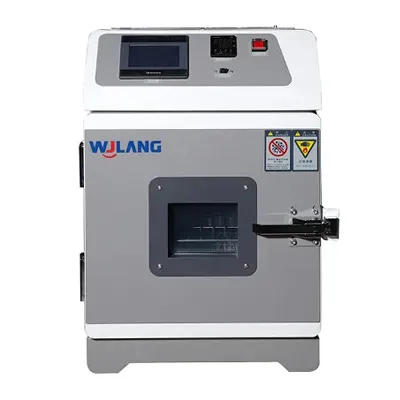
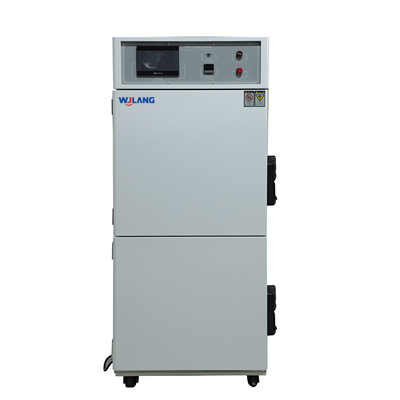
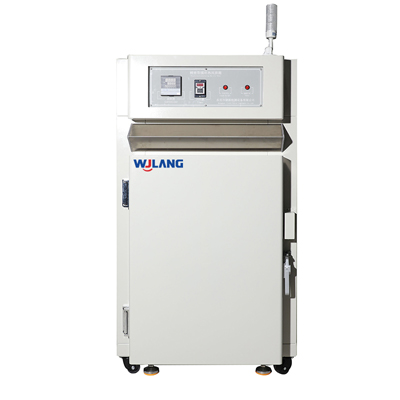
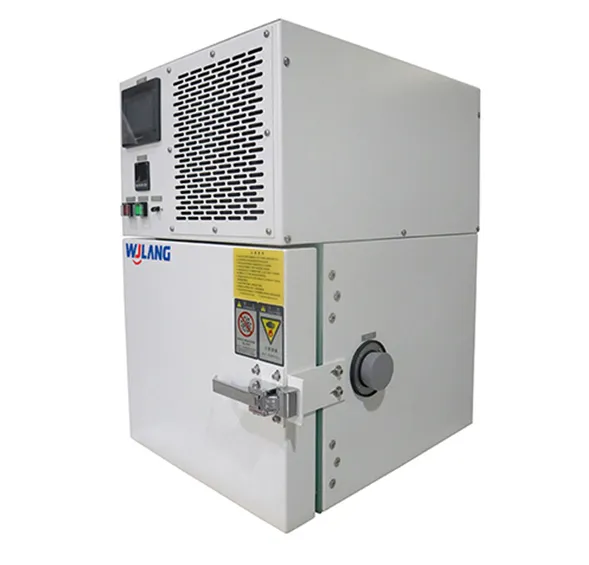
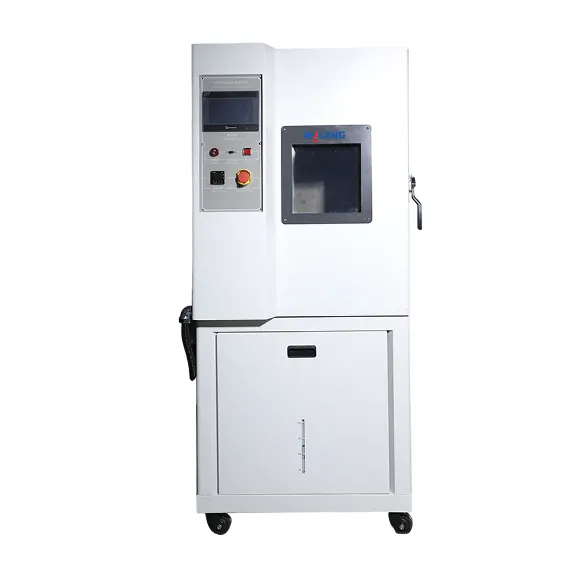
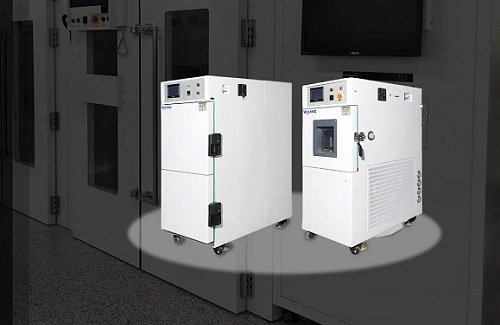
Published WJLANG products include compact desk-top ovens, standard high-temperature ovens and large-volume temperature systems. Selected 200°C models use PID and solid-state control, publish ±0.2°C stability and a nine-point uniformity result, and are offered in multiple internal dimensions. Larger custom systems can be designed around trolleys, heat-generating loads, airflow and process interfaces.
WJLANG also supplies broader environmental chamber solutions. This matters when a process originally described as “oven testing” actually requires cooling, humidity or programmed cycling. The engineering review should confirm whether an oven, temperature chamber, humidity chamber or thermal cycling system is the correct equipment family.
For an accurate proposal, provide the process and load data described in this guide. WJLANG can then define heater capacity, fan and duct arrangement, insulation, exhaust, sensor locations, controls, safety options and FAT. The proposal should state whether uniformity and heat-up figures are empty or loaded and what acceptance method will be used.
Frequently Asked Questions About Industrial Oven Uniformity
These questions address common misunderstandings about oven temperature control, airflow, loading, validation and equipment selection.
1. Is controller stability the same as oven uniformity?
No. Stability is variation over time at a point, while uniformity is the difference among locations. Both should be specified and measured.
2. Why does an oven pass empty mapping but fail with products?
The load adds thermal mass, blocks airflow, releases moisture or heat and changes the circulation path. A representative loaded survey is needed for process validation.
3. When should the process dwell time begin?
Begin dwell according to the validated process, often after a representative product sensor reaches the required temperature rather than when the display first reaches setpoint.
4. Is a vacuum oven always better for drying?
No. Vacuum helps certain moisture- or oxygen-sensitive processes, but it reduces convective heat transfer and adds sealing, pump and vapor-handling complexity. The product and solvent determine suitability.
5. How many sensors are needed for a temperature uniformity survey?
The number depends on chamber size, load and required standard. Nine points may be suitable for some small empty ovens, while large or critical production loads require more locations and product sensors.
6. What causes hot and cold spots in an industrial oven?
Common causes include blocked airflow, poor baffle balance, heater imbalance, door leakage, incorrect fan direction, dense loading, excessive exhaust and unrepresentative control-sensor placement.
Conclusion
A reliable industrial oven is one that delivers the required product temperature uniformly and safely under the approved load, not merely one that reaches the maximum setpoint when empty.
Uniformity begins with airflow and ends with process validation. Define the product, fixture, loading pattern, moisture or heat release and required temperature profile. Separate stability from spatial uniformity. Compare forced convection, gravity convection and vacuum according to the actual heat- and mass-transfer problem. Validate the usable workspace with calibrated sensors under representative conditions. Include safety information, exhaust, controls, facility requirements and a loaded acceptance test in the RFQ.
WJLANG can use these inputs to configure a standard high-temperature oven or a custom industrial system. Clear process data allows the engineering team to design the heater, airflow, workspace, controls and safety features around the real production requirement and to state performance in terms that can be verified during factory acceptance.
References
ASTM E145-19(2024), Gravity-Convection and Forced-Ventilation Ovens: https://store.astm.org/e0145-19r24.html
NFPA 86, Standard for Ovens and Furnaces: https://www.nfpa.org/codes-and-standards/8/6/nfpa-86
SAE AMS2750H, Pyrometry: https://saemobilus.sae.org/standards/ams2750h-pyrometry
Vietnam Wujinglang Technology
Vietnam Wujinglang Co., Ltd. is a high-precision reliability test equipment R&D & manufacturing provider, offering global environmental simulation and extreme test solutions for electronics, automobiles, aerospace, adhering to customer-first culture for sustainable development.
 English
  日本語
日本語  한국어
한국어  français
  Deutsch
  русский
  tiếng việt
  ไทย
ไทย  Malay
Malay 
 Know More